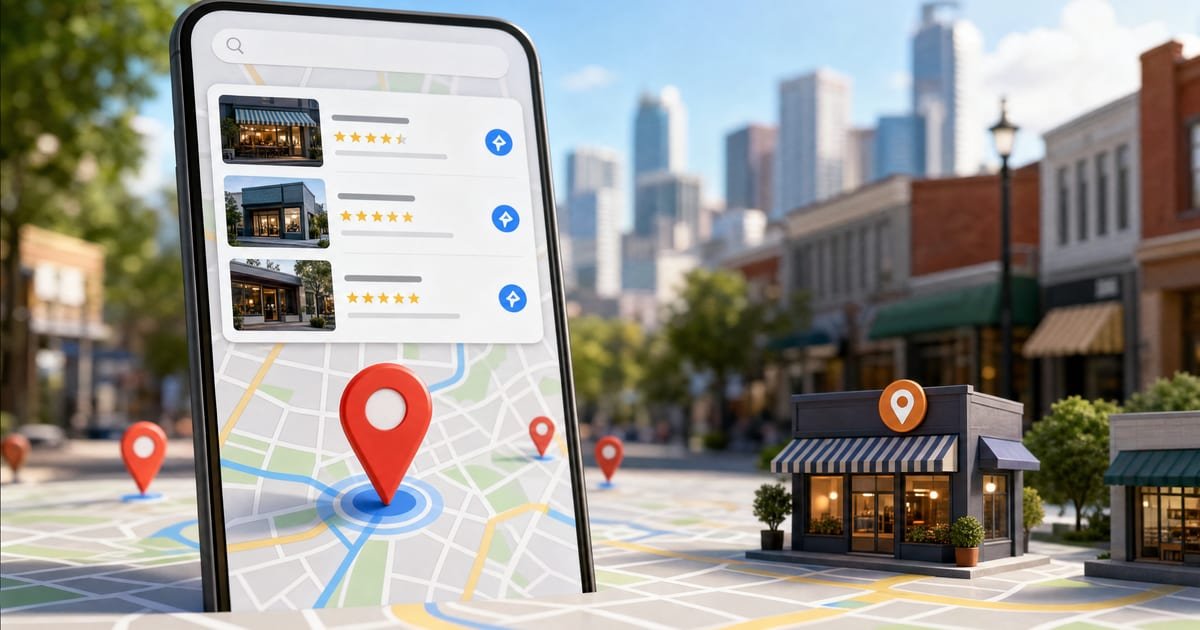
Search for “plumber near me” or “dentist in Pasadena” and look at what Google shows first: a map with three businesses under it. That block is the map pack, and for local businesses it is the most valuable real estate on the internet. Not page one. Not position one. Those three map spots.
Here is the short version: to get in, you need a complete and active Google Business Profile, a steady flow of reviews you actually reply to, and a website that backs it all up with local pages. That is the whole game. The rest of this post is how to do each part well.
Why the map pack matters so much
Roughly 46 percent of Google searches have local intent, and “near me” searches have grown more than 500 percent over the past five years. When someone types one of those searches, they are not researching. They are ready to call someone today.
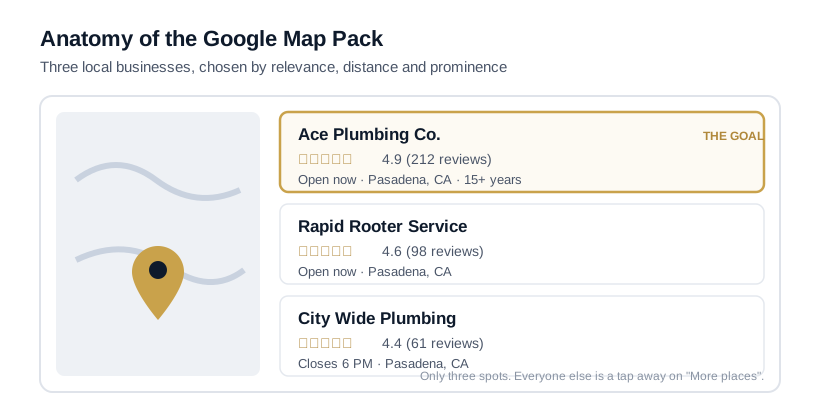
Google shows exactly three businesses. If you are one of them, you get the calls. If you are fourth, you are behind a “More places” tap that most people never make. That is why a small business with a modest website but a well-run profile routinely outranks bigger competitors in local results.
How Google picks the three
Google says it weighs three things: relevance (do you do what the person searched for), distance (how close you are), and prominence (how known and trusted you look). You cannot move your shop closer to the searcher, so the work is in relevance and prominence.
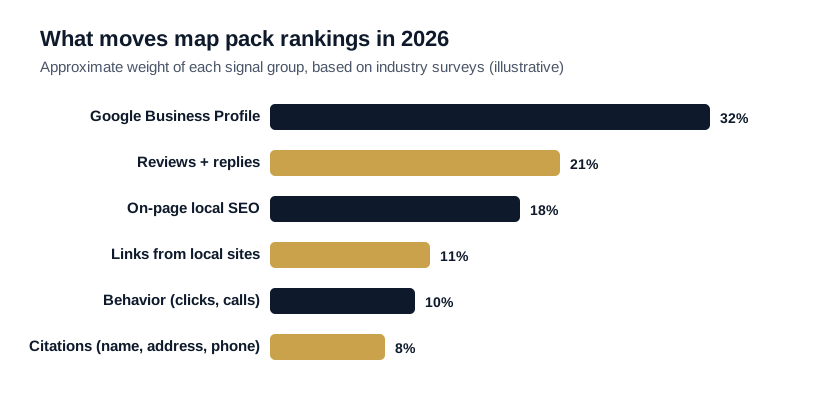
Notice what dominates: your Google Business Profile and your reviews together carry more weight than everything else combined. Good news for small businesses, because both are free. They just take consistency.
What changed in 2026
Two shifts matter this year.
First, AI now writes about your business. Since Google’s late-2025 update, Business Profiles get automatic AI summaries pulled from your description, reviews, and posts. Google’s AI Overviews also answer many “near me” questions directly. In both cases, the AI decides what to say about you based on what it can read. A thin profile gives it nothing to work with; a complete one hands it your best pitch.
Second, review velocity beats review totals. A steady drip of fresh reviews signals an alive, trusted business better than a big pile of old ones. Surveys show 97 percent of consumers read local reviews, and more of them than ever read the recent ones first. Ten reviews from this month beat two hundred from 2023.
Your Google Business Profile, done properly
This is the highest-leverage hour you can spend on marketing. Claim the profile, then work through this:
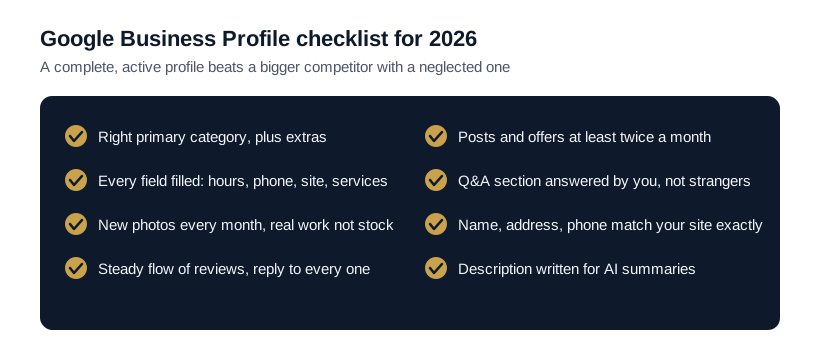
A few of these deserve extra attention:
- Categories. Your primary category is the strongest relevance signal you control. “Plumber” and “Emergency plumber service” rank for different searches, so pick the primary carefully and add every secondary that honestly applies.
- Reviews and replies. Ask every happy customer, make it easy with a direct link, and reply to all of them. Replies are read by both future customers and Google’s AI when it summarizes you.
- The description. Write it like the answer you want AI to give: who you serve, where, what makes you different. Plain sentences, no keyword stuffing.
- Photos. Real jobs, real team, updated monthly. Stock photos are obvious and do nothing.
Your website still does half the work
The profile gets you considered. Your website confirms you are legit and catches all the searches the map pack does not show. What matters:
- A page per city or area you serve, each with genuinely local content, not the same paragraph with the city name swapped. This is exactly how we built our own California city pages.
- A page per core service, so “water heater replacement” has somewhere specific to land.
- Matching details everywhere. Your name, address, and phone must be identical on your site, your profile, and every directory. Mismatches quietly erode trust.
- LocalBusiness schema and fast mobile pages, because most of these searches happen on a phone in a hurry.
If your industry is competitive, an industry-specific site structure helps too. It is why we publish dedicated pages for trades like plumbers rather than one generic services page.
Common mistakes that keep businesses out
- Setting up the profile once and never touching it again. Google rewards activity.
- Buying fake reviews. Filters catch them, and a suspension hurts far more than a slow month.
- Keyword-stuffing your business name (“Ace Plumbing | Best Plumber Pasadena CA”). Against guidelines, and Google has been suspending profiles for it.
- Ignoring the Q&A section, where anyone can answer questions about your business, including wrongly.
- A beautiful website with zero local pages, which leaves your profile doing all the lifting alone.
The takeaway
The map pack is not won by the biggest business. It is won by the most complete, most active, most reviewed one in the area. That is a consistency contest, and most of your competitors gave up on it months ago. Pair a well-run profile with a site that has real local pages, and you are ahead of most of the pack. For the broader basics, see our guide on getting your business to show up on Google.
Want to know where you stand? Run our free website audit to see how your site reads to Google and AI, or get in touch and we will map out your local plan, from profile to city pages.