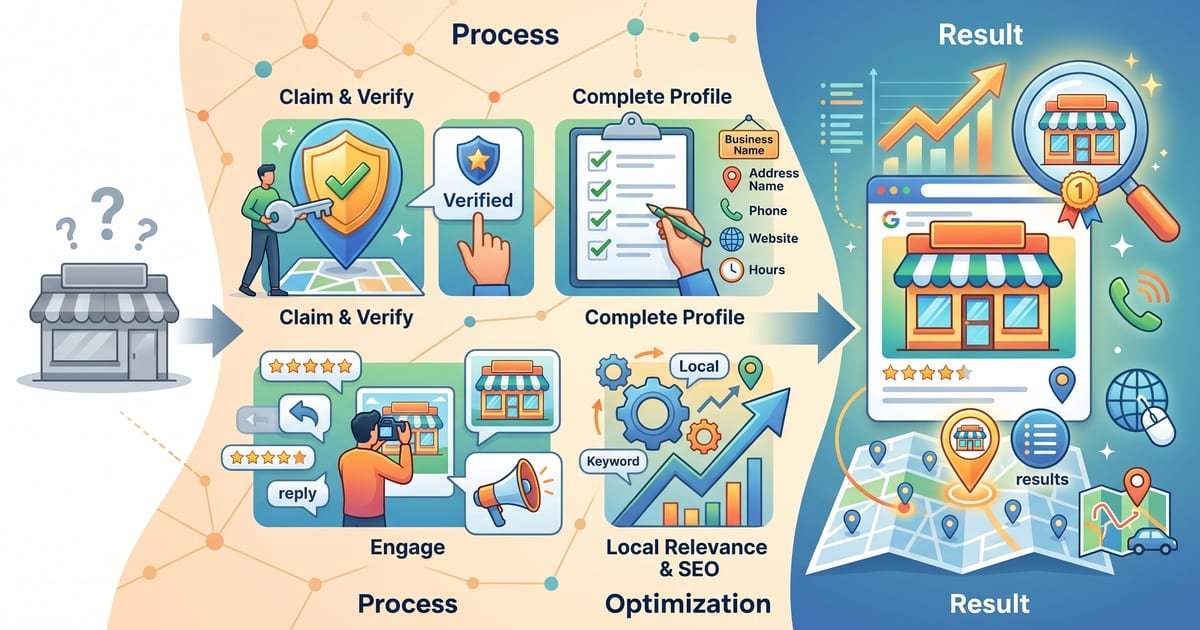
Most people find local businesses by searching Google. If you are not showing up, you are handing those customers to a competitor who is. The good news: getting found is mostly a set of practical steps you can work through. Here is how.
1. Claim and complete your Google Business Profile
This is the single biggest lever for local visibility, and it is free. Claim your profile at google.com/business, then fill out every field: business name, exact category, hours, service area, phone, website, and photos. A complete profile is what gets you into the map pack, that block of three local results near the top of the page.
Keep it active. Post updates, add new photos, and answer questions. Google rewards profiles that look alive.
2. Get reviews, and reply to them
Reviews are one of the strongest local ranking signals, and they sway customers who are deciding. Ask happy clients for a review and make it easy with a direct link. Then reply to every review, good or bad. A calm, helpful reply to a critical review often impresses readers more than the complaint hurts.
3. Keep your name, address, and phone consistent
Your business name, address, and phone number (NAP) should match exactly everywhere they appear: your website, Google, Yelp, Facebook, and any directories. Mismatches confuse Google and weaken your local ranking. Pick one format and use it everywhere.
4. Put local keywords on your website
Google needs to understand what you do and where. Work natural phrases into your pages, like “plumber in Simi Valley” or “Sacramento web design,” in your titles, headings, and copy. If you serve multiple areas, a dedicated page for each main city or service helps you rank for those searches.
5. Make your site fast and mobile-friendly
Most local searches happen on a phone. If your site is slow or hard to use on mobile, visitors leave and Google notices. A fast, mobile-first site with clear contact info and tap-to-call buttons both ranks better and converts better.
6. Cover the on-page SEO basics
A few fundamentals go a long way:
- A unique, descriptive title and meta description on every page
- One clear H1 heading per page
- Helpful content that answers what searchers actually ask
- Image alt text and clean, readable URLs
- Local business schema so Google understands your details
7. Build a few local signals
Get listed in reputable local directories, your chamber of commerce, and industry sites. A mention or link from a respected local source tells Google you are a real, trusted business in the area.
8. Do not ignore AI search
Search is changing fast. People now ask ChatGPT, Gemini, and Google AI Overviews for recommendations, and those tools cite sources. The same habits that help with classic SEO, clear answers, structure, schema, and an llms.txt file, also help you get mentioned in AI answers. Getting found now means showing up in both places.
How long does it take?
Some changes help within days, like completing your Google Business Profile. Ranking for competitive search terms usually takes a few months of steady effort. It is a compounding investment, not a switch you flip.
Want to know where you stand right now? Run our free website audit for a quick read on your SEO, or get in touch and we will map out a plan to get you found.